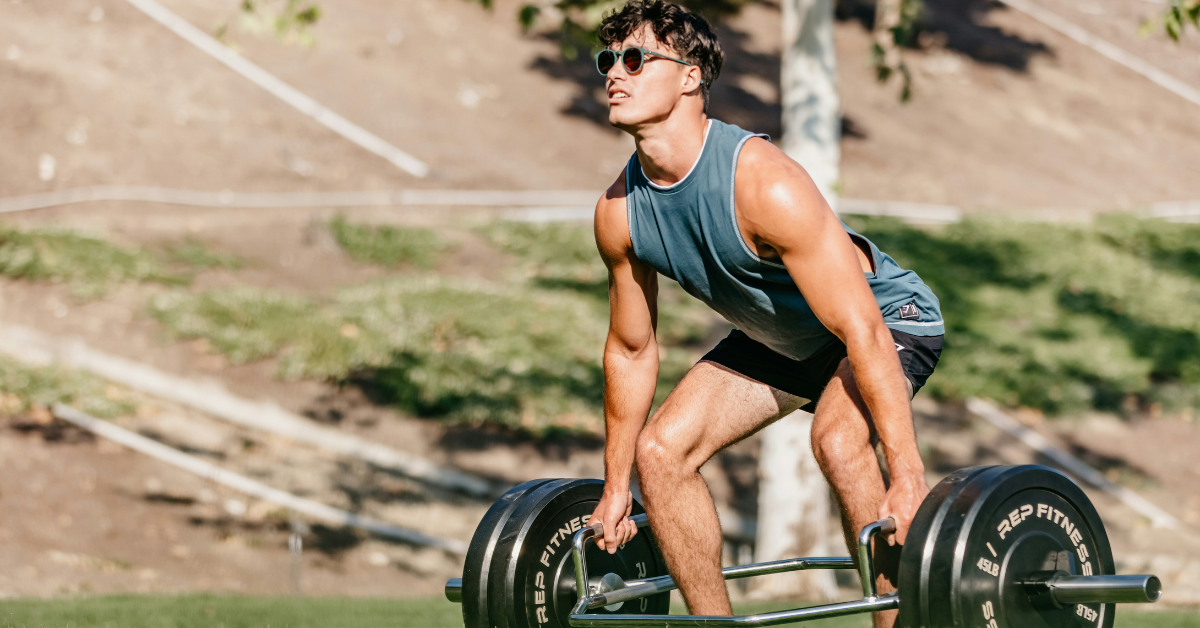
You have set up over the bar, braced your core, and pulled with everything you have. The heavy barbell breaks off the floor smoothly, passes your shins, and then—disaster strikes. Halfway up your thighs, the bar grinds to a sudden, agonizing halt. Your lower back arches, your knees shake, and no matter how hard you squeeze your glutes, you cannot stand up straight to complete the lift.
When a deadlift lockout fails, the knee-jerk reaction among most lifters and coaches is to blame the glutes or hamstrings. You are told to do more hip thrusts, rack pulls, or Romanian deadlifts. Yet, week after week, the lockout remains a sticking point.
The missing piece of the puzzle isn't in your legs, lower back, or hips. It is hiding in your upper body—specifically, in how you engage your lats. By applying one simple, counterintuitive biomechanical cue—tucking your armpits—you can eliminate bar drift, maximize mechanical leverage, and turn grueling deadlift lockouts into smooth, effortless finishes.
The Biomechanics of the Sticking Point
To understand why your upper back dictates your lower body’s lockout success, you must understand the concept of the moment arm.
In physics, a moment arm is the perpendicular distance between a joint (the axis of rotation) and the line of force applied (in this case, the vertical line created by gravity pulling down on the barbell). The longer the moment arm between the barbell and your hip joint, the more torque your hip extensors (glutes and hamstrings) must overcome to pull you upright.
When you initiate a deadlift, gravity wants to pull the weight straight down. If the bar drifts even one inch forward away from your shins or thighs, that moment arm instantly increases.
When the barbell floats away from your body mid-lift:
- The force requirement on your glutes multiplies exponentially.
- Your spine is subjected to extreme shear forces as your lower back attempts to compensate.
- The bar path turns into an arc rather than a straight vertical line.
Your glutes aren't failing because they are weak; they are failing because the weight has moved into a position of severe mechanical disadvantage. To keep the bar glued to your body throughout the pull, you need a powerful muscle group capable of pulling the upper arms backward toward your torso. That muscle group is the latissimus dorsi.
What the Lats Actually Do in a Deadlift
The latissimus dorsi (lats) are the largest muscles in the upper body. While most gym-goers view them primarily as pulling muscles used for pull-ups and rows, their primary function in the deadlift is isometrically stabilizing the spine and maintaining bar closeness.
The lats originate along the spine, thoracolumbar fascia, and pelvis, and insert directly onto the humerus (upper arm bone). When fully contracted, they perform three key functions during a deadlift:
- Shoulder Extension: Pulling the upper arm back toward the torso, keeping the bar pressed flush against the shins and thighs.
- Spinal Rigidity: Engaging the thoracolumbar fascia, which acts as a natural lifting belt around your midsection, locking the lumbar spine into a safe, neutral position.
- Depression of the Scapulae: Pulling the shoulder blades down away from the ears, effectively shortening the distance between the hips and the barbell.
If your lats are slack, your shoulders roll forward, your thoracic spine rounds excessively, and the barbell drifts forward. By actively locking your lats before the bar leaves the floor, you clamp the barbell against your center of mass and eliminate useless movement.
Why "Squeezing Shoulder Blades" Is the Wrong Cue
For decades, well-meaning lifters have relied on the cue: "Scapular retraction—squeeze your shoulder blades together."
While squeezing your shoulder blades together works wonders for the bench press or upper-back bodybuilding rows, it is counterproductive during a deadlift.
When you pull your shoulder blades backward, you shorten your arms. A shorter arm length means you have to bend over further to reach the barbell, creating a deeper hip angle and making the lift harder off the floor. Furthermore, the moment a 400-plus pound barbell leaves the floor, gravity will forcefully pull your shoulder blades forward anyway. You cannot hold scapular retraction under maximum loads.
Instead of pulling your shoulder blades back, you must pull them down. This is scapular depression. Tucking your armpits depresses the shoulders, engages the lower lat fibers, lengthens your reach to the bar, and locks your torso into a rigid, unbreakable pillar.
How to Execute the "Armpit Tuck" Cue
Mastering lat engagement does not require years of practice; it simply requires changing your mental focus during setup. Here is how to lock in the "Armpit Tuck" step by step before every rep:
1. Protect Your Armpits
Imagine someone is trying to tickle your armpits or steal a hundred-dollar bill tucked under each arm. Before you initiate the pull, clamp your upper arms down firmly against your ribcage.
2. Bend the Bar Around Your Shins
Once you take your grip on the barbell, attempt to "bend" the bar backward around your legs. To do this, externally rotate your shoulders by trying to point the insides of your elbows (the elbows' creases) straight forward toward the wall in front of you. This motion instantly fires up the lats.
3. Pull the Slack Out
With your armpits tucked and elbows turned, pull upward on the bar just enough to hear the metallic "clack" of the barbell against the weight plates without letting the plates leave the floor. This establishes maximum tension across your upper body and lats before your legs begin pushing into the ground.
The Ripple Effect: From Floor to Lockout
When you successfully execute the armpit tuck, a positive chain reaction occurs throughout the entire lift:
- Off the Floor: The barbell stays pinned to your shins, moving in a true, uninterrupted straight vertical path.
- At the Knees: Because the bar hasn't drifted forward, your hips remain close to the barbell. You avoid the dreaded "good-morning" deadlift where your hips shoot up and your lower back takes the full load.
- At the Lockout: As the bar clears your knees, your hips only have a few inches left to travel to meet the bar. Because your upper back hasn't collapsed or rounded forward, your glutes can easily squeeze to full extension without hitching or leaning back.
Key Takeaways
Fixing a stubborn deadlift lockout rarely requires throwing more heavy hip work at the problem. More often than not, it is a technical breakdown caused by lat slack.
- Stop squeezing your shoulder blades back; focus on pulling your shoulder blades down.
- Tuck your armpits shut to engage the lats, secure your spine, and eliminate forward bar drift.
- Keep the bar in contact with your body from the moment it leaves the floor until you stand fully upright.
By turning your lats into rigid steel cables from the very start of your setup, you secure your leverage, protect your lower back, and finally smash through your deadlift lockout plateaus.